
See a list of all the winners and commended artists here.
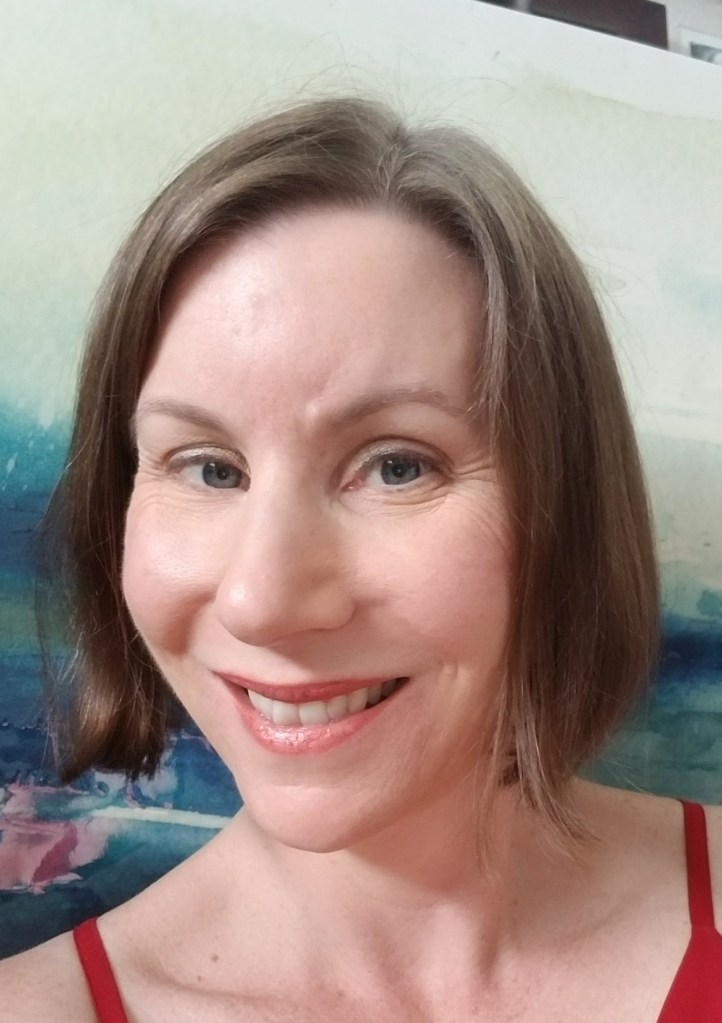
We are offering a warm welcome today to Ariane Prinz, a writer living in London, Ohio. She earned an MFA from The Ohio State University, has received an Ohio Arts Council Individual Excellence Award, and has published in such journals as Salt Hill, The Portland Review, and Beloit Poetry Journal. She enjoys time spent in the natural world.
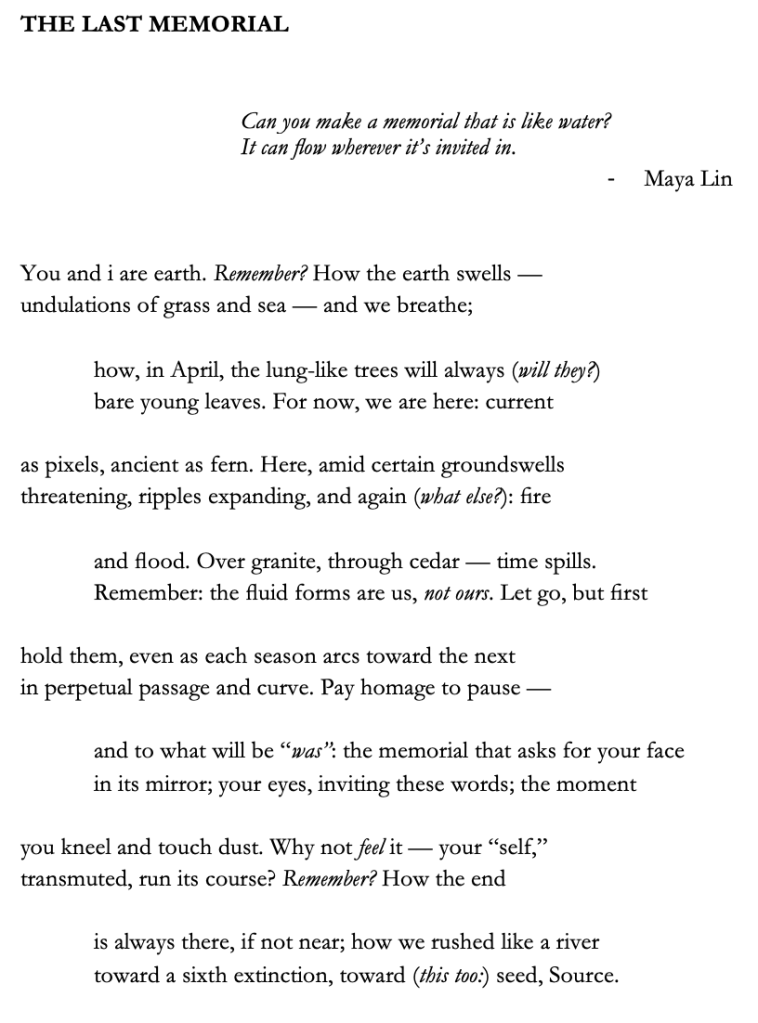
Ariane is the last of our “Maya Lin sisters”, poets who chose to write about the brilliant, Ohio born artist, architect and designer. Ariane gives us her own beautiful take on Lin underneath the poem below.
ABOUT THIS POEM:
I was moved to write about Maya Lin — the great architect and sculptor, known best for designing the Vietnam Veterans Memorial in Washington, D.C. — because of her connection to the earth and the way her art carries a clarity and simplicity like the water and stone that so much of it is made of.
She shares: “My affinity has always been toward sculpting the earth. This impulse has shaped my entire body of work.” In learning about her art, I was struck by her interest in Ohio’s Hopewell earthworks, and how they have influenced many of her environmental installations. I was also attracted to her themes that resonate with my own: time and memory, passage and pause.
This poem nods to her more recent final “memorial” project (What is Missing?), addressing biodiversity and habitat loss — and the declining health of our planet. “I would like to make one last memorial focusing on the extinction of species,” she wrote. “I envision a memorial not as a singular, static monument, but one that would exist in many places at once, as well as one non-physical place, existing as a site on the internet.” It’s a digital interface that, once again, reflects her way of making art that asks us to protect and restore what we can of the earth.
To me, the essence of her work feels entirely captured by the image on the cover of her book Boundaries: from a black background, an up-close portrait of two hands cradling a speckled, palm-sized stone. See this, hold it, protect it. The image is a masterful communication of care — and probably the truest seed of inspiration for this poem.
 Women of Ohio
Leave a comment